Europe’s Financial Crisis Leads to Suicide Surge
The harsh spending cuts introduced by European governments to tackle their crippling debt problems have not only pitched the region into recession — they are also being partly blamed for outbreaks of diseases not normally seen in Europe and a spike in suicides according to the AP.
 The report goes on to say that the “worsening health was driven not just by unemployment, but by the lack of a social welfare system to fall back on. People need to have hope that the government will help them through this difficult time”.
I think that it is “nice” to have public assistance programs available for the truly needy. There is however something inherently wrong with these social programs. I believe these programs promote government dependency.
A growing dependency of government is what got us into so many of our problems, and what is our own government doing? They are promoting that very dependency. Instead of raising people up, we are keeping them down. We are creating a generational dependency on social programs.
According to the 2012 Index of Dependence on Government more people than ever before—67.3 million Americans, from college students to retirees to welfare beneficiaries—depend on the federal government for housing, food, income, student aid, or other assistance.
Once considered to be the responsibility of individuals, families, neighborhoods, churches, and other civil society institutions, Americans are looking to the government to take care of them.
The ethic of self-reliance joined with a promise to the brotherly care of those in need appears threatened, well nearly absent in today’s society. There was a time, before all of the social programs, when people took care of each other. If you were having trouble the first thing you did was —anything you could — to get back on your feet.
There was no sitting around waiting for the government to come to the rescue. Your church, or family or friends helped out, and you helped others when they were in need. We took care of ourselves without a dependency on the government.
Our social programs including Social Security, Medicare and Medicaid are unsustainable in their current form.
Over the next 25 years, more than 77 million baby boomers will begin collecting Social Security checks, drawing Medicare benefits, and relying on long-term care under Medicaid. There will be no event so financially challenging to these programs over the next two decades than this shift of boomers into retirement.
More than 70% of Federal spending goes to dependency programs.
With so many Americans on or soon to be on the government dole and nearly half of all Americans not paying income taxes, there is no way we can pay for all of this and our spending will spiral out of control (it’s almost there now). With an increase in recipients and a decrease in the number of workers left paying for these programs, we will soon reach our fiscal tipping point much as other countries have already, and this will put us in a certain domestic debt crisis of our own.
In doing research for this article I have found no evidence that Americans are suffering a rise in medical ailments and suicides. But we have not quite reached the same crippling financial problems as our friends across the pond.
…but trust me when I tell you, it’s coming.
Senate Narrowly Passes First Budget in Four Years
So finally, the Senate passes a budget. (Wall Street Journal) How is it possible to run a country without a budget? Well, simple really, the government doesn’t have to play by the same rules you and I do. Can you imagine if you just didn’t keep track of your finances for four years? Just continue to spend like there was no tomorrow and if you felt like you were getting too deep in debt, just announce that you are going to extend or raise the amount of debt you are going to have?

The U.S. Senate narrowly passed the budget. Do they ever pass anything with everyone in agreement? I doubt it. The budget plan was passed by a 50-49 vote in the Democratic-controlled chamber. Four Democratic senators facing tough re-election campaigns in 2014 joined all the Senate Republicans in opposing the measure, which seeks to raise nearly $1 trillion in new tax revenues by closing some tax breaks for the wealthy.
I’m a bit confused as to how the government method of accounting works. They’re going to raise $1 trillion by closing some tax breaks, OK, I guess I buy that, although I think it is more speculation than fact. But I recently heard the president say that by increasing the debt ceiling to $16 trillion instead of $18 trillion he has reduced our National debt by $2 trillion.
…What?
Congress will be out of town for a two-week spring recess.
I guess after three months of work, Congress is worn out and needs a little va-ca. I guess passing a major tax increase, raising the federal debt limit, allowing $85 billion in spending cuts to take effect and enacting a bill to keep the government operating only through Sept. 30, really takes it out of you.
This budget mess is not over. It still needs to pass the house and we all know that it is not going to be that easy. With the Democrat controlled Senate and Republican controlled House, it seems like nothing ever gets done. Well, nothing of any importance. If there is a spotted, ring-neck, hootie bird spotted in a field in Whocares county in the state of Ridiculous, they have no problem agreeing that there should be millions spent of studying it and determining why it will only crap when it is facing north. …or some such nonsense.
The problem is that each side has a different view on how our country should be run. The Democrats, keeping up the stereotype, seem to be all about tax and spend and “entitlement” programs with no regard for a budget, whereas the Republicans appear to be for a smaller government and controlled spending.
The House wants a balanced budget by 2023
The House plan ostensibly brings the government’s taxes and spending into balance by 2023 with cuts to domestic spending even below the levels of automatic across-the-board cuts roiling federal programs now, and it orders up dramatic and controversial changes to Medicare and the tax code.
The Senate plan, by contrast, includes $100 billion in upfront infrastructure spending to bolster the economy and calls for special fast-track rules to overhaul the tax code and raise $975 billion over 10 years in legislation that could not be filibustered. Even with that tax increase and prescribed spending cuts, the Senate plan would leave the government with a $566 billion annual deficit in 10 years, and $5.2 trillion in additional debt over that window.
As if all of this isn’t enough to make your head explode, coming this summer… Congress must again raise the government’s statutory borrowing limit or risk defaulting on the federal debt. …The good ole Debt Ceiling problem is coming back.
So the Senate passed a budget, the first in 4 years, but guess what? It will never be passed into law as it is. …and no one seems to every compromise.

I think it’s better for me to just stick my head back in the sand and stop watching the news.
…I have had just about enough.
Administration Moves $500M in Palestinian Aid, as Agencies Scramble to Delay Furloughs
FOX News – As federal agencies scramble to avert or delay sequester-tied furloughs, the Obama administration continues to spend millions of dollars on foreign aid to the Palestinians – and seek millions more, despite past efforts by Congress to freeze the money.
 So what the hell, pardon my French, is going on? Our spending is out of control, the debt has so many zeros that it looks like computer code and supposedly our government has to make cuts, due to the sequester, that keeps school kids from touring the white house, and they are giving $500M to the Palestinians?
“The Obama administration is seeking a further $200 million to fund programs for the Palestinians.”
Arrrrgh!! …is that how you spell that noise I just made? Well, the next sound you hear just might be my head exploding! Try, that I might, I just can’t understand what is going on in Washington. You know if there was some tragic natural disaster, with thousands killed and even more hungry and homeless, then I have no problem helping out another country, but here is what that money we are giving them is for:
- $195.7 million for economic development and humanitarian assistance. Huh?
- $100 million earmarked specifically for narcotics control. What?
- $200 million for direct budget support. Are you effin kidding me?
The kicker in all of this is that Congress said no to this nonsense and froze the administration’s request for funds. But with a total disregard for Congress and the law of the land, this administration just does what it wants.
So imaging you and your wife are struggling to make ends meet. As a matter of fact, you are so in debt that you have to borrow money from your parents and your in-laws. Your in-laws by the way really don’t like you at all and are giving you the money as an investment, don’t be confused, it is a loan not a gift.
You are so badly in debt that you have even asked your credit card companies to raise your credit (debt) limit.
…and then, …ready?
Your wife pays your neighbor’s bills; the neighbors can’t stand you by the way and want you to move out of the neighborhood, and then gives them a bunch of cash so they have some “walking around” money. Of course you told her that you couldn’t afford it and that you had money problems of your own that you can’t handle and even went so far as to forbid her from giving them any money, but she ignored all of that and went ahead and gave it to them anyway. As a matter of fact, she is trying to get together more money so she can give the neighbors another cash gift.
And if that’s not enough, Israel, who is supposed to be our only real ally in that region (but this administration doesn’t seem to feel that way) and who is surrounded by nations that want to wipe them off the face of the earth, told us that they were “strongly opposed” to the financial aid by us. So what… Seems to be the administration’s view on Israel’s position.
Everything is upside down and backwards. How did we get here?
H&R Block Snafu Delays Refunds
…mandatory field on tax form left blank
 Marketwatch.com — H&R Block, the nation’s largest tax preparer, confirmed that its software failed to fill out a mandatory field on Form 8863, which is used to claim educational credits. The IRS would not say what percentage of the roughly 600,000 faulty returns came from H&R Block (US: HRB), but the company received thousands of complaints on its Facebook page and on Twitter.
I have to tell you, I would be pretty mad if this had happened to us. My wife and I used TurboTax to prepare and file our tax return; we have for the last 5 years or so, and have never had a problem. I used H&R Block when I was younger and all I remember was an expensive “loan” in order to get my return immediately. I thought the days of those short term refund loans were over but they are not. Now there is what is called a RAC / RAL or Refund Anticipation Check / Loan.
RALs are those short-term loans usually at outrageous interest rates, for the amount of an expected refund. Tax prep fees are usually deducted from your return amount also. A “good” RAL might have an APR of 40%; a bad one can end up costing 10 times that much.
When combined with other the cost of the RAL can approach loan-shark levels.
Thankfully, this might the last year people need to be warned about RALs. That’s because the RAL industry is getting squeezed by federal regulators, who are cutting off bank funding to the biggest RAL lenders, and by the Internal Revenue Service, who is making it easier to get refunds quickly and without crazy fees.
You know, what’s really problematic is the fact that you have to pay H&R Block something like $150 for 30-40 min of time with their “tax consultant”. If I’m paying for an “expert” to prepare my taxes, I would expect there to be no errors. I realize the “tax consultant” is a human, prone to making mistakes, but this goes farther than the individual tax preparers, the fault falls on H&R Block for failing to stay up-to-date with the IRS and failing to properly train their “tax consultants”.
H&R Block explained that a form had changed, Form 8863 relating to student tax credits, and that in previous years, five lines on the form could be left blank for a “no” answer. Starting this year, preparers must enter an “N” in those fields or risk a delay.
H&R Block said it learned about the tax form change after it had submitted hundreds of thousands of tax returns. The IRS said it was aware of the problem and it is continuing to review the situation and work with “affected software companies to assist in the processing of those tax returns.”
You know, I was always instructed when filling out any form, to never leave a “blank”. If it’s a “no” answer, mark it “no”. If something doesn’t apply, use “n/a”. You would think that H&R Block’s highly trained tax preparers would follow this thinking just from common sense, especially if you are dealing with the Government.
I feel sorry for Mr. & Mrs. John Q. Public who filed their tax return and is expecting their refund only to find out it’s going to take at least 21 days for the IRS to figure everything out and issue the refund.
Now, my good friend TurboTax is not exempt from errors either. Last week, the Minnesota Department of Revenue warned taxpayers against using TurboTax to file their state income taxes, finding 10,000 returns had problems. In a terse statement, the Minnesota Department of Revenue said it would stop processing tax returns filed through Intuit (the company that operates TurboTax) if the problem is not fixed.
Well, I don’t live in Minnesota so it doesn’t affect me but if I did, I wouldn’t be as upset with TurboTax since I know full well that I am filing my return on my own with the help of a computer program. There’s not a $300 an hour “Tax Consultant” using their knowledge and expertise to make sure my return is done correctly.
If you want to insure your taxes get prepared correctly, seek out an Accountant or Bookkeeper certified to prepare tax returns.
… Often times you get what you pay for.
The Fiscal Cliff
Are You Facing Your Own Fiscal Cliff?
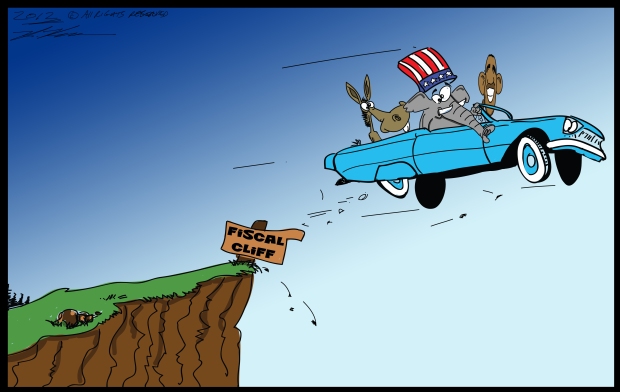
You can’t turn on the News without seeing the talking heads discussing “Fiscal Cliff” this or “Fiscal Cliff” that. What is the Fiscal Cliff anyway? Will it really affect you and me? Well, let’s see. I’ll try to put all of this in a nut shell to make it easier to figure out and then we’ll go from there.
OK, “The Fiscal Cliff”, where did this name come from? I don’t remember ever hearing this term used before so I did a little research. Well, no wonder we never heard it before, this is a new term, most likely made up by an Ivy League political speech writer, used by Ben Bernanke (The Federal Reserve Chairman) in his testimony to Congress earlier this year. Not everyone thinks the term “cliff” is accurate in describing what we, the Nation, are facing. The Center on Budget and Political Priorities likens it to more of a “slope” and The Economic Policy Institute says no, it’s a mere obstacle course. Whatever verbal imagery you want to use, one thing is for sure, the impending consequences are not good.
Well, January 1 or around there, $500 billion in tax increases and $200 billion in spending cuts are scheduled to take effect. According to the Congressional Budget Office (that might be an oxymoron!) if allowed to take place that will likely throw us into a recession. None of the bean counters in Washington can agree on how fast the recession will hit us. If Wall Street freaks out it will happen quickly, but who knows, it could take a while. No matter what, everyone is in agreement that this stuff should not be allowed to kick-in. What they are not in agreement on is how to fix it. …we’ll address that in a little bit.
Tax Increases and Spending Cuts. But what’s that really mean?
Tax Cuts:
There are 5 or so tax related provisions that are set to expire at the end of the year, here are a couple that could affect you and me:
- Bush Tax Cuts – If you remember, these cut individual tax rates, lowered capital gains and dividends rates, and expanded the child tax credit and others. If these cuts are extended it could cost $203 billion next year.
- Payroll Tax Holiday – This little gem decreased the payroll tax rate on employees from 6.2% to 4.2%. If this is kept it is estimated that it will cost $115 billion in 2013.
- 2009 Stimulus – There’s that little ditty in the 2009 stimulus that has in it the expansion of the child credit, American Opportunity tax credit (helps families pay for college) and the expansion of the earned income tax credit. For this one if they kept everything it would cost$10 billion next year.
Spending Cuts:
Here are a couple of the what some feel are ridiculous spending cuts, that no one really wanted, that will go into effect next year:
- Caps on discretionary spending – This will set a limit that policymakers will have to stick to. This could reduce spending by $78 billion next year.
- Budget Caps – Cuts to defense and non-defense spending, some predicting a crippling effect on all affected departments and agencies. You’re looking at around $110 billion next year for this one.
- Doc Fix – This is another one of those quirky things that if it was to hang around would cost around $14 billion next year.
Debt Ceiling:
Of course it all depends on how much the government spends and taxes, but the groups that study stuff like this figure the debt limit will have to be raised between $730 billion and $1.25 trillion to avoid the debt ceiling for 2013, that’s whether anything is done about the “fiscal cliff” or not.
So What If We Just Thelma and Louise This Thing?
It seems that law makers on both sides of the isle can’t make a decision on how to handle this problem. Democrats want higher taxes on the rich and the Republicans won’t stand for any tax increases. What’s screwed up is that if we take the plunge over the cliff, taxes will go up higher than either sides wants.
Hold on to your wallet because it’s you and me that will feel the effect of a cliff dive. Taxes will go up for nearly every taxpayer and most businesses. You know what an increase in taxes means, yep, less of your paycheck in your pocket. And when businesses get hit by tax increases they don’t just say “oh, that’s OK. We’ll just make less profit”, no they pass the joy on to us, the consumers. You can expect the cost of everything to increase, with the exception of Twinkies, but that’s something we’ll discuss in a future article. It would seem to me that there are only three options available. 1 – Make a Deal. This would be the best bet, to make a deal between the two. The problem is that Congress moves at the speed of molasses in the winter and I don’t see how there is any time left to work out a deal. It’s been over 4 years and they haven’t been able to produce a budget for our country. 2 – Just Extend It! There’s always the “put off for tomorrow what you can do today” mentality and just extend everything. No loss, no gain. 3 – Ladies and gentlemen, the Captain has turned on the We’re Screwed Sign. If you haven’t already done so, please stow any cash you might have underneath the mattress in your bedroom or in a can buried in the back yard. Please take your seat and fasten your seat belt. And also make sure your seat back and folding trays are in their full upright position. There are no emergency exits on this flight so don’t bother looking for them. Please assume the bracing position, lean forward with your hands on top of your head, and kiss your butt good bye! …end transmission.
Same Price for Less Food?: The Secrets the Food Companies are Keeping from You
The current state of the economy is difficult enough, but paying more and getting less doesn’t help, especially when it comes to putting food on the table. Lately, the amount of food consumers are getting for the price they are paying just isn’t adding up.
Chip companies are sending out bags with about 20 percent less product than what was packaged in 2009. (The spokesperson for the company said that the extra 20 percent was just a “limited time offer.”) This trend can also be seen walking down the pasta aisle. This quick and easy dinner option used to be sold at 16 ounces per box and is now weighing in at 13.25 ounces per box. The same can be said for canned vegetables which also used to weigh in at 16 ounces a can and can now be found weighing as low as 13 ounces. This list goes on and on and ranges from canned tuna to sugar.
But how are companies getting away with charging the same prices for less food?
According to The New York Times and John T. Gourville, a marketing professor at the Harvard Business School, it’s all about the packaging.
“Consumers are generally more sensitive to changes in prices than to changes in quantity. Companies try to do it in such a way that you don’t notice, maybe keeping the height and width the same, but changing the depth so the silhouette of the package on the shelf looks the same. Or sometimes they add more air to the chips bag or a scoop in the bottom of the peanut butter jar so it looks the same size,” said Gourville.
One example of this would be the new “fresh packs” of crackers. Though the box shows stacks of crackers that are broken down and packaged into several groups so they stay fresh for longer, the packs are actually a marketing ploy to give you less food…a whopping 15 percent less!
Another excuse companies use is that they are trying to make their products “greener.” Procter and Gamble is using this method stating that it’s “using at least 15 percent less energy, water or packaging than the standard [size].” What they fail to mention is that if there’s less packaging, there is less product.
No matter what the companies say to try and excuse their products, now is the time to be more observant than ever. Make sure to closely examine the labels on items before sticking them in your cart. Also try to avoid grabbing the newer packages. Though the packaging may state all the qualities that make it better, the standard container is likely to have more product.
Tips for Tipping: Is the Recession Changing the Rules?
Tipping is one of those awkward social requirements that can sometimes make people a little frazzled. Leave a bad tip for bad service or be merciful and remember the wait staff and how your tip fuels their livelihood?
Tipping used to be a relatively easy process. Do a little math, recall how quickly you got your refills and there was that magic number. Nowadays, people are factoring in the Great Recession and are finding ways to shave off costs from their bill. This isn’t just causing confusion, its causing some pretty lousy tips too.
Also, since many restaurants are offering specials and discounted prices, what do you tip? Do you leave a tip based on what the total of your bill is or what you would have paid had your entrée not been on the specials menu? Let’s go back to the beginning and see if we can sort it out from there.
Tips, which actually stands for “To Insure Proper Service,” originated during the Middle Ages in Europe and came to the U.S. even before our independence in 1776. Due to age of the practice, most everyone grows up viewing tipping as a social requirement and for good reason too! About 90 percent of a waiter’s paycheck comes from the tips a restaurant’s patrons leave!
A friend of mine from college has a job for which the majority of her pay comes from tips. If the customers’ tip well, she ends the night with a heavier wallet, if not then she is financially strapped for the week ahead. We were talking about her new job one day when she flat out admitted that she wasn’t the best tipper before she got her job. That has now changed significantly.
Tips also make a difference for my step-sister who works at a coffee shop. She sometimes makes up to an extra $20 a shift because the money customers leave in the tip jar. This only brings up another question. Am I required to put money in tip jars?
I usually don’t leave a tip in the jar (sorry baristas) and find that, thankfully, I don’t get too many judgmental stares. The way I see it, a coffee shop employee’s paycheck doesn’t depend on whether or not there is money in the tip jar, it just acts as a bonus.
Another industry where tipping makes a big difference is the beauty industry. Generally, I will tip at least $3 when I get my eyebrows done, and try to tack on $5 when I get a manicure. The way I see it, cosmetologists not only have to deal with some sore sights (one word: toenails!), if you don’t tip them at all you might want to watch out next time the hot wax comes out!
Overall, don’t make tipping too difficult for yourself or too depressing for the person serving you. Here are a few simple tips to take away:
– Most cell phones have tip calculators built in, use it!
– Use good judgment and fairness when it comes to nontraditional areas that don’t have set percentage expectations.
– If you get bad service, maybe leave a 14-15 percent tip instead of 20, but don’t be too brutal.
-And, as Nicholas Demeda once said, “If you can afford to dine out, you can afford to tip well.”
Sources:
The Palm Beach Post
Bay Area Bites
 DEBTHELPER.COM