The Fiscal Cliff
Are You Facing Your Own Fiscal Cliff?
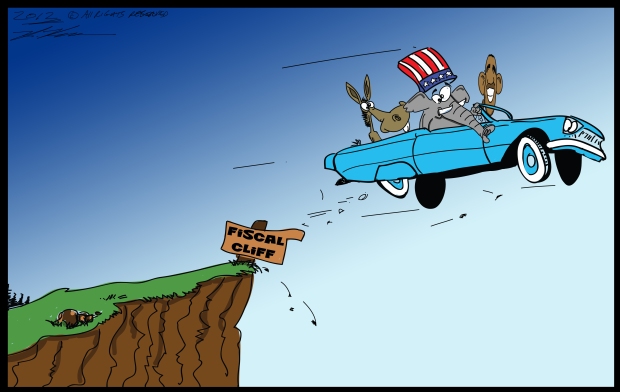
You can’t turn on the News without seeing the talking heads discussing “Fiscal Cliff” this or “Fiscal Cliff” that. What is the Fiscal Cliff anyway? Will it really affect you and me? Well, let’s see. I’ll try to put all of this in a nut shell to make it easier to figure out and then we’ll go from there.
OK, “The Fiscal Cliff”, where did this name come from? I don’t remember ever hearing this term used before so I did a little research. Well, no wonder we never heard it before, this is a new term, most likely made up by an Ivy League political speech writer, used by Ben Bernanke (The Federal Reserve Chairman) in his testimony to Congress earlier this year. Not everyone thinks the term “cliff” is accurate in describing what we, the Nation, are facing. The Center on Budget and Political Priorities likens it to more of a “slope” and The Economic Policy Institute says no, it’s a mere obstacle course. Whatever verbal imagery you want to use, one thing is for sure, the impending consequences are not good.
Well, January 1 or around there, $500 billion in tax increases and $200 billion in spending cuts are scheduled to take effect. According to the Congressional Budget Office (that might be an oxymoron!) if allowed to take place that will likely throw us into a recession. None of the bean counters in Washington can agree on how fast the recession will hit us. If Wall Street freaks out it will happen quickly, but who knows, it could take a while. No matter what, everyone is in agreement that this stuff should not be allowed to kick-in. What they are not in agreement on is how to fix it. …we’ll address that in a little bit.
Tax Increases and Spending Cuts. But what’s that really mean?
Tax Cuts:
There are 5 or so tax related provisions that are set to expire at the end of the year, here are a couple that could affect you and me:
- Bush Tax Cuts – If you remember, these cut individual tax rates, lowered capital gains and dividends rates, and expanded the child tax credit and others. If these cuts are extended it could cost $203 billion next year.
- Payroll Tax Holiday – This little gem decreased the payroll tax rate on employees from 6.2% to 4.2%. If this is kept it is estimated that it will cost $115 billion in 2013.
- 2009 Stimulus – There’s that little ditty in the 2009 stimulus that has in it the expansion of the child credit, American Opportunity tax credit (helps families pay for college) and the expansion of the earned income tax credit. For this one if they kept everything it would cost$10 billion next year.
Spending Cuts:
Here are a couple of the what some feel are ridiculous spending cuts, that no one really wanted, that will go into effect next year:
- Caps on discretionary spending – This will set a limit that policymakers will have to stick to. This could reduce spending by $78 billion next year.
- Budget Caps – Cuts to defense and non-defense spending, some predicting a crippling effect on all affected departments and agencies. You’re looking at around $110 billion next year for this one.
- Doc Fix – This is another one of those quirky things that if it was to hang around would cost around $14 billion next year.
Debt Ceiling:
Of course it all depends on how much the government spends and taxes, but the groups that study stuff like this figure the debt limit will have to be raised between $730 billion and $1.25 trillion to avoid the debt ceiling for 2013, that’s whether anything is done about the “fiscal cliff” or not.
So What If We Just Thelma and Louise This Thing?
It seems that law makers on both sides of the isle can’t make a decision on how to handle this problem. Democrats want higher taxes on the rich and the Republicans won’t stand for any tax increases. What’s screwed up is that if we take the plunge over the cliff, taxes will go up higher than either sides wants.
Hold on to your wallet because it’s you and me that will feel the effect of a cliff dive. Taxes will go up for nearly every taxpayer and most businesses. You know what an increase in taxes means, yep, less of your paycheck in your pocket. And when businesses get hit by tax increases they don’t just say “oh, that’s OK. We’ll just make less profit”, no they pass the joy on to us, the consumers. You can expect the cost of everything to increase, with the exception of Twinkies, but that’s something we’ll discuss in a future article. It would seem to me that there are only three options available. 1 – Make a Deal. This would be the best bet, to make a deal between the two. The problem is that Congress moves at the speed of molasses in the winter and I don’t see how there is any time left to work out a deal. It’s been over 4 years and they haven’t been able to produce a budget for our country. 2 – Just Extend It! There’s always the “put off for tomorrow what you can do today” mentality and just extend everything. No loss, no gain. 3 – Ladies and gentlemen, the Captain has turned on the We’re Screwed Sign. If you haven’t already done so, please stow any cash you might have underneath the mattress in your bedroom or in a can buried in the back yard. Please take your seat and fasten your seat belt. And also make sure your seat back and folding trays are in their full upright position. There are no emergency exits on this flight so don’t bother looking for them. Please assume the bracing position, lean forward with your hands on top of your head, and kiss your butt good bye! …end transmission.
How insurers know if you’re lying
After many decades of being on the receiving end of customer scams, the insurance industry is on to you. And now that the sagging economy is leading to more attempts to score free money with fraudulent insurance claims, insurers are becoming more vigilant. A well established list of red flags, known to insurance insiders as “suspicious loss indicators” help the industry zero in on potentially bogus claims.
Why care if your neighbor is scheming?
Insurance fraud is big business in the United States. Fraud exceeds $40 billion a year, according to FBI statistics. You pay that price in the form of higher insurance premiums, which cost the average family $400 to $700 annually. Fraud bureaus around the country reported a spike in the number of fraud cases in 2009 compared with the previous year, according the Coalition against Insurance Fraud.
That’s suspicious!
Since its creation in 1992, the crime bureau has developed 23 “suspicious loss indicators.” In 2009, the bureau’s 1,000 member organizations which include insurance companies, self-insured organizations and transportation-related businesses, including car rental companies, made about 143,000 requests to the bureau for help assessing suspicious claims.
• High debt or financial distress on the part of a claimant, detected by insurance company investigators through forensic accounting.
• Adding or increasing home insurance or business insurance coverage shortly before damage or theft occurs.
• Lack of police reports.
• Damage or theft of old, obsolete items or inventory, or of multiple family heirlooms for which it’s difficult or impossible to establish accurate value.
• A history of losses and previous claims.
• A claimant who’s unusually calm after a major loss.
• Suspicious-looking or handwritten receipts for repairs or replacement of covered property.
Arson alert
The National Fire Protection Association estimates that 300,000 intentional fires occur in the United States each year, causing 400 to 500 deaths and $1 billion in property damage. But only 5% to 7% of arson offenses result in convictions, according to the FBI. The U.S. Fire Administration says these are signals that a fire should be further investigated:
• It occurred during a renovation or to a structurally damaged building.
• Valuable or sentimental property, personal items, important papers or pets were removed from the premises.
• There are no accidental or natural causes at the point of origin.
• There’s an unusual presence of combustible materials or multiple separate fires.
• The fire started immediately after a family argument or shortly after family members left the premises.
• The fire spread unnaturally or caused excessive damage.
• Firefighters’ access was blocked by vehicles or by contents pushed up against entry doors.
• The homeowner’s movements are unaccounted for.
• The value of damaged items seems improbable, given the policyholder’s income.
Source
Everything You Ever Really Needed to Know About Personal Finance on the Back of Five Business Cards

A few days ago, I had lunch with an individual who is considering hiring me to give a multi-hour seminar to a business convention on personal finance. This person knows me from the local community and is a reader of The Simple Dollar and he felt that I might be the right person to give such a presentation.
During the lunch, out of the blue, he asked me to give a five minute nutshell version of what I would present to the group. I thought for a minute, pulled a pen out of my pocket, and asked him for five business cards. In those next five minutes, I summarized everything I know about personal finance in a pocket-friendly presentation.
I saved the business cards, scanned them in, and thus, for your enjoyment, is my presentation (with some extensive helper notes so you can know what I was actually saying while drawing these cards).
Keep reading at The Simple Dollar
 DEBTHELPER.COM